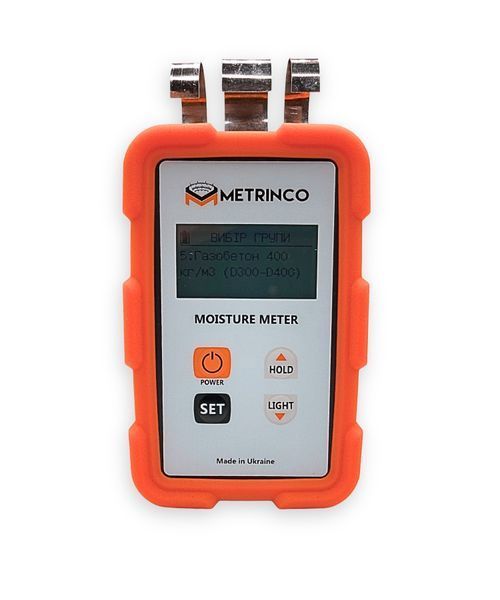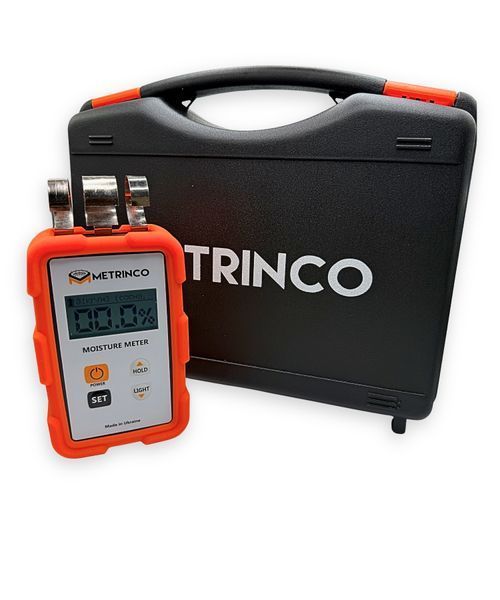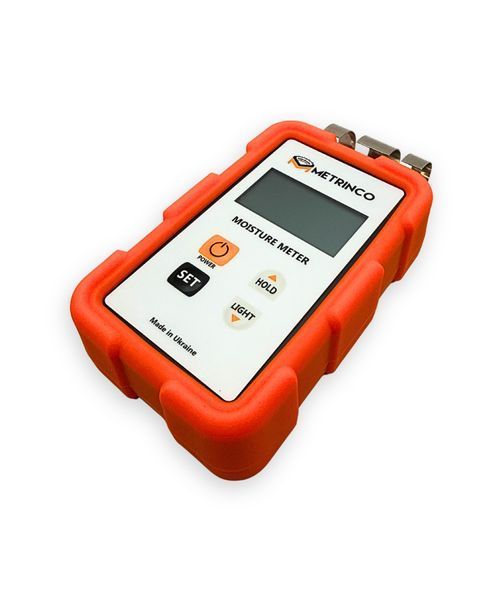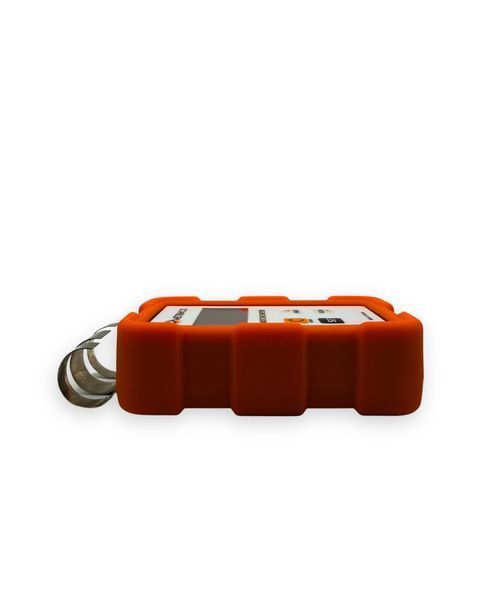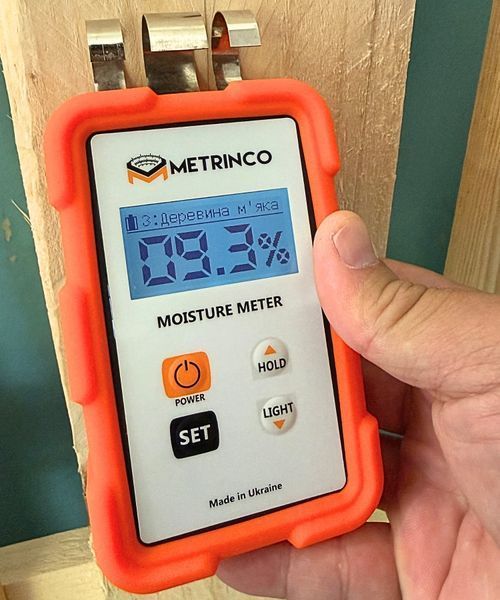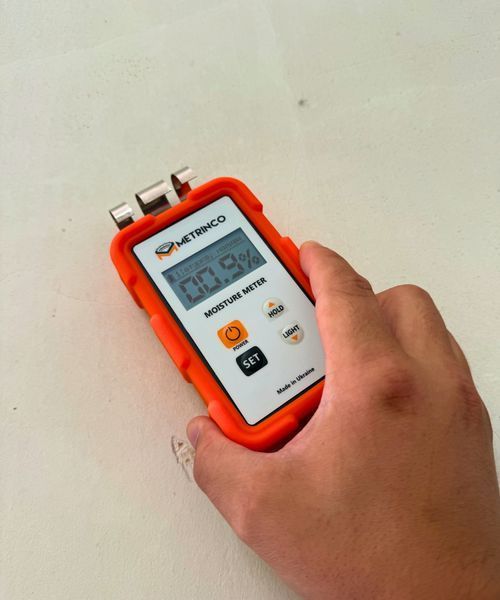
METRINCO M120B Building Material & Wood Moisture Meter
The M120B is a professional non-destructive moisture meter for building materials and wood. Designed for screed and plaster drying control, acceptance of construction work, and locating areas of elevated moisture in walls and floors. Dielectric (capacitive) method, scanning depth up to 100 mm, 21 calibration groups for building materials plus 2 wood groups. Measurement requires no pins and leaves no marks on the material.
Key advantages
- Three spring-loaded stainless steel electrodes. They conform to surface irregularities on their own — consistent fit against brick, plaster and rough-sawn timber.
- Scanning depth up to 100 mm. Assesses moisture within the bulk of screed, concrete and other materials, not just the surface layer. Effective depth depends on the material's density, moisture and structure.
- 21 calibration groups for building materials. Dedicated calibrations for aerated concrete D300–D600, cement-sand screed, concrete grades M200–M400, sand-lime and clay brick, fibre cement, natural stone.
- Material groups spelled out in full. "Cement screed, cement mortar (2000 kg/m3)" instead of cryptic codes — scrolls in the status line, shown in full in the selection menu.
- Honest over-range indication. Wet material shows a blinking ">limit" instead of a made-up number; as the material dries, the transition from over-range indication to a numeric reading is stable, with no toggling between modes at the range limit.
- Rugged bumper case, large 128×64 backlit display, HOLD. Runs on 3×AAA, auto power-off after 5 min.
Specifications
| Measurement method |
dielectric (capacitive), non-destructive |
| Material groups |
23 (21 building + 2 wood) |
| Range, building materials |
0 – upper limit of the group (up to 17.9 %) |
| Range, wood |
0 – 30 % (above 20 % indicative) |
| Accuracy |
±1 % |
| Resolution |
0.1 % |
| Scanning depth |
up to 100 mm (depends on material density and moisture) |
| Sensor |
3 spring electrodes, stainless steel |
| Display |
graphic 128×64, backlit |
| Power |
3 × AAA (1.5 V) |
| Auto power-off |
5 min |
| Operating temperature |
0…+60 °C |
| Made in |
Ukraine |
Material groups
Plaster and self-levelling floors · cement-sand screed and cement mortar · aerated concrete D300–D600+ · fibre cement (eternit) · lightweight concrete 1900–2000 kg/m³ · concrete M200–M400 · sand-lime brick · lime mortar · sandstone, limestone · clay brick, porous and dense · ceramics, tiles · marble · softwood (pine, spruce) and hardwood (oak, beech).
Who it is for
Builders and site managers — checking screed readiness before flooring, accepting plastering work. Building surveyors — mapping damp areas on walls and floors by scanning. Roofers and carpenters — verifying structural timber before installation.
For woodworking and kiln-drying control, see METRINCO M120W — with wood groups by density.
FAQ
What is the difference between M120B and M120W?
M120B is the building version: 21 material groups, 2 wood groups, 100 mm depth. M120W is the woodworking version: wood groups by density, shallower depth. For screed, concrete and brick, choose M120B.
Does it damage the surface?
No. The method is non-destructive: the electrodes press against the surface without piercing or marking it.
Can I measure freshly poured screed?
Yes — that is the main use case. While the screed is wet the meter shows over-range; once it dries down to the limit it switches to numeric readings, which then fall towards the levels acceptable for the specific follow-on work.
Does rebar affect the reading?
Yes, metal within the scanning depth raises the result. On reinforced structures measure at several points between bars and rely on the lowest value.
What is the minimum material thickness?
Ideally 100 mm or more — otherwise the field "sees" whatever is beneath the sample. Stack thin samples without air gaps.
Why is wood limited to 30 %?
Above fibre saturation the accuracy of absolute moisture determination by the dielectric method drops significantly. For structural timber (12–20 % target) the range is more than sufficient; anything above 30 % needs drying anyway.